

What Is Titanium CNC Parts
An alloy with a host of unique properties, titanium is often an optimal choice for CNC machined parts with specialized applications. Titanium has an impressive strength-to-weight ratio and is 40% lighter than steel while being only 5% weaker.
Advantages of Titanium CNC Parts
Strength and Lightweight
Titanium boasts an exceptional strength-to-weight ratio. This means that while titanium parts can boast the tensile strength that rivals certain steels, they do so at about half the weight. For industries where every gram counts, this is a game-changer.
Corrosion Resistance
Dive into the deepest parts of the ocean, and you'll find submarines and marine equipment built with titanium. Why? Its outstanding ability to resist corrosion from seawater.
Biocompatibility
Titanium's biocompatibility has given hope to countless individuals in the form of medical implants and prosthetics.
Resilience in Heat
Jet engines and rocket components deal with extreme temperatures. Titanium's high melting point makes it perfect for this task.


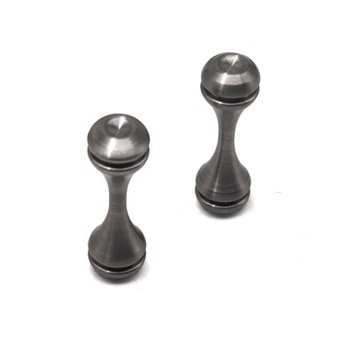
Material:Titanium alloy Gr2, Gr5,Ti6Al4V,etc. Process:CNC turning, CNC milling, Surface treament:Polish, Brush, Sandblast, Black, color, rainbow PVD, etc
Why Choose Us
Fast and Reliably Delivery
Iterate part designs quickly and accelerate product development with quick-turn parts. Our automated design analysis will help spot any difficult to machine features before your design is sent to the manufacturing floor and save you from costly reworks further down the product development cycle.
Advanced Capabilities
Get anodizing, tighter tolerances, and volume pricing options through our network of manufacturers at Hubs. You'll find plating (black oxide, nickel), anodizing (Type II, Type III), and chromate coating in larger part quantities; tolerances down to ±0.001 in. (0.020mm); and cost-efficient machined parts at higher volumes to lower piece-part price.
Infinite Capacity
Eliminate downtime spent waiting for parts and safeguard in-house machining with on-demand relief and infinite manufacturing capacity.
Manufacturing Analysis and Online Quotes
When you upload your 3D CAD file to request a quote, we'll analyze your part geometry to identify any features that may be difficult to machine such as tall, thin walls or holes that cannot be threaded.
Key Considerations for Selecting the Right Material for Your titanium CNC parts
There are many factors you should consider when selecting a material for your CNC machining project. Some of the key considerations are:

Purpose of the part
How will the part be used? Over the years, engineers have discovered what materials are good for what purpose. For example, aerospace components need materials that are strong and lightweight (e.g., aluminum, titanium, and high-strength steel alloys). Identifying the application(s) for which a CNC machined part will be used helps narrow down what materials are appropriate based on this gathered knowledge. If the component has multiple uses, it is important to consider all of them when choosing a material.

Operating temperature
What operating temperatures will the part be exposed to during use? A CNC machined part may be subject to high, low, or fluctuating temperatures during operations. It is vital the material you select has an operating temperature range broad enough to accommodate these conditions. Otherwise, the component may become brittle (if exposed to too low temperatures) or soft/warped (if exposed to too high temperatures).

Environment
What environmental conditions will the part be exposed to during use? The conditions to which a CNC machined part will be exposed can affect its short-term and long-term performance. For example, if it needs to perform in an environment with high temperatures, high humidity levels, or corrosive chemicals, it may be damaged if it is not built to withstand these conditions.

Operational stress/strain
What operating conditions will the part be exposed to during use? A CNC machined part may experience high stress and strain during operations. In these cases, it is essential to choose a material that can stand up to these demanding operating conditions.
Here are some tips for avoiding problems during CNC machining titanium parts
Lower your cutting speed if you are experiencing excess heat buildup or smearing; also try to glide softly into the entry point, instead of directly feeding into the stock.
Sharpen your cutting edges if you are seeing smearing or edge line problems.
Perform frequent tooling inspection and maintenance or replacement when machining titanium and replace cutting edges when you first see wear.
Fine tune your feed rates, likely based on trial and error; this may help to reduce heat buildup or smearing as well.
Utilize a high pressure, large flow volume of coolant with a preferred spindle and tool setup.
Reduce radial engagement to reduce the time that the cutting edge can generate heat, therefore allowing it to cool before the cutting tool re-enters the titanium workpiece
This may also allow for an increase in surface speed, without impacting tooling temperature significantly.
Ensure every single piece of equipment that completes the machining setup, including the workpiece itself, are all stable. Stability and rigidity in the setup will reduce vibrations, tolerance issues and heat generation.
Utilize conventional, or climb milling, to produce a greater amount of material at the entry point of the mill (for greater heat transfer to the chip) and thinner amount of material at the exit point of the mill lower the risk of chip adhesion issues.
Pay attention to axial depth: change it for each cut, to prevent tooling oxidation; also follow the ratio 8:1 around thin walls or unsupported features to avoid deformation.
Why Titanium for Titanium CNC Parts
Precision and Durability
Titanium, renowned for its exceptional strength-to-weight ratio and corrosion resistance, plays a pivotal role in achieving precision in CNC-machined aerospace parts. The durability of titanium ensures that these components withstand the harsh conditions they may encounter during aircraft operation.


Weight Reduction Benefits
In the race for fuel efficiency and enhanced performance, the weight of aerospace components is a critical factor. Titanium's lightweight nature contributes significantly to reducing the overall weight of aircraft, leading to improved fuel efficiency and operational capabilities.
Corrosion Resistance
Aerospace environments expose components to corrosive elements. Titanium's inherent corrosion resistance is a game-changer, ensuring that CNC-machined parts maintain their integrity over the long term, even in challenging atmospheric conditions.


Temperature Resistance
Aerospace systems operate in extreme temperature ranges. Titanium's ability to withstand both high and low temperatures makes it an ideal choice for CNC parts, ensuring reliability and performance in diverse environmental conditions.
Cost-Effectiveness in the Long Run
While the initial investment in titanium CNC parts may be higher, the long-term benefits far outweigh the costs. The durability and low maintenance requirements of titanium components result in substantial cost savings over the lifecycle of an aircraft.


Versatility in Aerospace Applications
Titanium CNC parts find applications in various aerospace systems, from structural components to critical engine parts. The versatility of titanium allows engineers to design and implement innovative solutions that enhance overall aircraft performance.
Popular Titanium Alloys for Titanium CNC Parts
Titanium is versatile, and its various alloys are a testament to that. By introducing different elements, metallurgists have tailored titanium to fit specific needs.
Titanium Grade 5 (Ti6Al4V)
This alloy is a jack-of-all-trades, striking a balance between strength and ductility. It's ideal CNC machining, thanks to its versatility.
Titanium Grade 2
Purity is Grade 2's hallmark. While it might not boast the strength of some other alloys, its remarkable corrosion resistance and weldability make it a popular choice.
Titanium Grade 7 and Grade 23
With enhanced corrosion resistance and purity, they cater to niche needs, be it resisting acids or constructing medical implants.
Challenges of CNC Machining Titanium CNC Parts
Every metal has its quirks, and titanium is no exception. Machining titanium requires a blend of expertise and patience.
Fortunately, our experienced team of experts and fully-vetted supply chain ensures the highest quality for your CNC machined titanium parts. Here's some of the things we take care of during titanium projects:

Tackling Tool Wear
Titanium is robust. While that's excellent for the end product, it does mean that tools can wear out faster. The solution? Tools made of durable carbide or those with coatings tailored for titanium machining.

Managing Heat
Titanium doesn't dissipate heat swiftly, unlike metals like aluminum. This localized heat buildup can hasten tool wear. Combatting this.

Contending with Flexibility
Titanium's strength might suggest rigidity but can exhibit flexibility, leading to vibrations during machining. It's essential to have robust work-holding systems and machinery to cope with this nuance.
How to Clean CNC Machining Titanium CNC Parts
●Straightness is a form tolerance introduced in GD&T, which is used to indicate that the linear elements on the CNC lathe parts maintain an ideal straight line state, which is commonly referred to as the degree of straightness. Straightness tolerance is the maximum amount of variation allowed by the actual line to the ideal straight line, and there is no benchmark requirement. The standard form of straightness is used to ensure uniform two-dimensional tolerances on the surface of CNC lathe parts, as well as the axis straightness used to control the central axis of the part.
●Take out the CNC machined titanium parts and rinse them with clean water. Take a dry soft towel or cotton cloth and gently try the titanium to wipe in circular motions.
Titanium CNC parts exhibit excellent heat tolerance capacity and can withstand wide range of high temperature applications. The machined parts are strongly resistant to various chemicals. The machined parts are lightweighted and exhibits high strength. Titanium due to its exceptional qualities are in great demand by many manufacturers to produce high quality precision turned Titanium components.
Refer latest price list of cnc titanium components and turned components.
CNC titanium components are inbuild with high ductility and strength to weight ratio of any metal. Titanium precision turned components possesses excellent machinability property. The machining process can form high quality parts with complex geometrics and tight tolerances.
Titanium cnc machining and cnc milling titanium for critical aerospace, battery, and electronics applications.
Titanium CNC machining parts are widely used in the medical, aerospace, food and beverage, designing, automotive, electronic, military, ocean, engine and consumer goods applications. Titanium turned parts are popular for its dimensional accuracy and precise specifications.
Importance of Polishing Titanium CNC Parts Surfaces

Improves the Lifespan
A titanium CNC parts with a superb finish tends to last longer because it is durable. Also, the parts are resistant to corroding environmental factors. With such aspects, the titanium CNC parts guarantees a greater lifespan.

Improves Electrical Conductivity
For any metallic part, electrical conductivity is a crucial factor. titanium CNC parts materials could be a better conductor; polishing its surface improves its conductivity. There is little resistance in the metal as the electricity passes through it.

Improves Beauty of The Part
Upon polishing the titanium, its functionality enhances, bettering its usability. Also, we improve the texture of the part, leaving it with a glossy look.

Improves Wear Resistance
By polishing titanium, the frictional force on the surface reduces. Therefore, as the metal part comes into contact with a different surface, the wear is minimal. Such a feature improves the item's lifespan, especially when there is friction involved.
Certificate


Our Products
Ruixing was founded in 2005 and passed ISO9001-2015. We are specialized in machining services for 18 years more. We are your professional partner of machining parts.
Our service focus on the professional machining service for Industry Automation, Aerospace parts, Knitting Machine Parts, Instruments & Meters, Sensor, Medical Equipment, Beauty & Personal Care, Consumer electronics and hardware, etc.


FAQ